
(also: cardan shaft, constant-velocity shaft, homokinetic joint, CV joint)
General
The driveshafts in the T4 Syncro transmit torque from the gearbox to the front wheels and from the rear differential to the rear wheels. In doing so, they connect sprung to unsprung masses and must accommodate the movement of the wheels. For this purpose, the shafts feature joints at both ends, which are positively connected to the shaft bar via appropriate splines. During suspension compression, not only does the articulation angle in the joints change, but the distance between the wheel and gearbox also decreases, compressing the shaft and requiring length compensation. On the front axle, the wheel-side joint must additionally be able to transmit torque across the steering angle during cornering.
In the T4, as is standard in passenger cars, the cardan shafts are designed to be maintenance-free. The joints are packed with grease and protected from environmental influences on the outside by CV boots. As long as the boots show no signs of damage, maintenance work is generally not required. However, it is advisable to inspect the bellows regularly for tears or holes that could allow water and dirt to enter the joint. The driveshaft joints in the T4 are actually very durable. However, if water gets into the bellows, the constant movement of the components churns it with the grease into an emulsion, which loses its lubricating properties and, combined with ingress of dirt, leads to premature wear of the joints.
Front cardan shafts
Despite the asymmetrical design of the gearbox, the front driveshafts are of equal length on the left and right. This is because unequal driveshaft lengths can affect the steering under heavy acceleration (torque steer). To ensure that both driveshafts could be made equal in length despite the front differential being offset far to the left, the right-hand flanged shaft was lengthened accordingly and supported. On Syncro models, this is achieved via the final drive, which has a hollow main shaft through which the flanged shaft is extended towards the right front wheel.
Regardless of model year, fixed joints were always installed on the wheel side of the front axle; these provide a large articulation angle without allowing any axial displacement. On the gearbox side, 108 mm CV joints were always used, which compensate for both articulation angle and length changes during suspension compression. Only the 111 kW TDI and V6 engines were fitted with even larger inner joints, which measure 120 mm in diameter.
The front driveshafts were modified in 1996. Not only were the splines on both ends changed, but the length of the shaft bar was also increased by approximately 11 mm. This was due to suspension modifications: both the front and rear track widths were widened by 22 mm as part of the major product update (facelift).


| Fitting position front | fitted | Splines wheel side | Splines gearbox side | Part number | Shaft bar length |
|---|---|---|---|---|---|
| left + right | up to 12/95 | 33 | 33 | – | 471 mm |
| left + right | from 01/96 | 27 | 28 | – | 482 mm |
| left + right (111 kW TDI and V6 only) | from 01/96 | 27 | 23 | – | 482 mm |
The front cardan shafts can be disassembled very easily for repair. After removing the CV boots, the shaft circlip on the gearbox-side joint can be removed and the joint pressed off the shaft. On the wheel side, align the joint straight and wind in the central bolt until it bottoms out. Once resistance is reached, increase the tightening torque and wind the bolt in further. This forces off and partially shears a lightly dimensioned snap ring over the splines. The joint can then be pulled off.


Rear cardan shafts
On the rear axle, the driveshafts are designed in two different lengths due to the asymmetrical layout of the differential. Extending a flanged shaft to achieve symmetrical driveshafts was not necessary here, as the rear is not a steered axle. The rear driveshafts fitted prior to the major product update (facelift) use the same inner and outer joints as the front shafts. That is, a fixed joint is always fitted on the wheel side, and a CV joint with length compensation on the gearbox side. The shaft splines therefore correspond to those at the front; only the length of the shaft bar differs.

From 01/96, newly developed driveshafts were introduced on the rear axle. A plunging joint was now fitted on the wheel side which, like the inner joint, can compensate for changes in cardan shaft length during compression and rebound.


The CV joint on the gearbox side was reduced from 108 mm to 100 mm, and the spline count was changed from 33 to 25 teeth. Furthermore, the rubber boots were replaced with thermoplastic CV boots.
| Fitting position rear | fitted | Splines wheel side | Splines gearbox side | VW part number | Shaft bar length |
|---|---|---|---|---|---|
| right | up to 12/95 | 33 | 33 | 701501202A 701501202C | 439 mm |
| left | up to 12/95 | 33 | 33 | 701501201A 701501201C | 579 mm |
| right | from 01/96 | 25 | 25 | 701501202E | 454 mm |
| left | from 01/96 | 25 | 25 | 701501201E | 581 mm |
| left (TDI) | from 01/96 | 25 | 25 | 7D0501201A | 561 mm |
From 03/98, the left (long) cardan shaft was available in two different lengths. The reason for this was the introduction of the 02G series rear differentials for the high-torque TDI engines. Larger crown wheel and pinion sets were installed in these final drives, making it necessary to widen the differential housing by 20 mm to the left. The reduced distance to the wheel was then compensated for with a correspondingly shorter driveshaft.

The wheel hubs (701501647 and 701501647A) were not modified across model years with regard to their internal splines and are identical front and rear. Consequently, the external splines of the wheel-side joints are also identical regardless of model year or fitting position, measuring 38 teeth.
The spare parts situation is significantly tighter for the new version of the rear driveshafts than for the old version with fixed joints on the wheel side. Unfortunately, VW does not offer a spare part for the outer joints with length compensation; only the complete half-shaft with pre-assembled joint is available, parts of which are now discontinued. The likely reason is the pressed sheet-metal cap on the joint, which cannot be removed non-destructively and forms a single unit with the CV boot. The outer joints of the new version cannot be dismantled by threading in the central bolt, as they are secured with a circlip.
To disassemble, the pressed sheet-metal cap must be knocked off the joint, which cannot be done without damaging it. The joint can then be articulated and the ball bearings removed. Unfortunately, no spare parts are available for repairing the CV joint. The bellows can, for instance, be replaced with a universal silicone bellows fitted directly onto the outer circumference of the joint. Note, however, that without the sheet-metal cap, the joint can easily be articulated too far, causing the balls to drop out. When fitting the shaft to the vehicle, ensure that the outer joint is not bent too sharply. Once installed and during operation, the absence of the cap poses no problem.


According to the VW parts catalogue, part number 7M0598103 is designated as a repair kit for the gearbox-side joint, but it has also since been discontinued. A suitable CV joint from the quality manufacturer GKN is available in the allradbus shop. The outer diameter and internal splines are identical; however, sealing to the flanged shaft is not achieved via an adhesive cork gasket as on the T4 Syncro. It is nevertheless essential to seal the CV joint to the flange to prevent the ingress of dirt and water. Sealing can be carried out, for example, using a liquid flange sealant on the previously cleaned mating surfaces. A matching bellows for the inner joint is available in our shop.
-
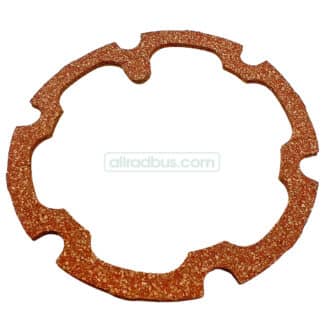 Cork gasket for OEM 100 mm CV joint9,90 €
incl. VAT
plus shipping costs
Delivery time: 2–4 working days
-
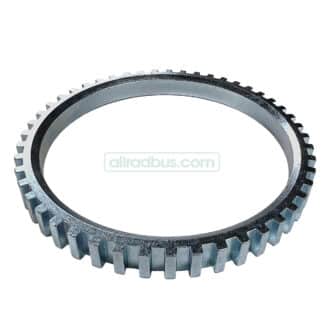 ABS Ring for Driveshafts15,90 €
incl. VAT
plus shipping costs
Delivery time: 2–4 working days
-
 CV Joint Grease MoS23,90 €
incl. VAT
plus shipping costs
Delivery time: 2–4 working days
-
 CV joint 100 mm99,90 €
incl. VAT
plus shipping costs
Delivery time: 2–4 working days
-
 Driveshaft spacer rings 108 mm196,90 €
incl. VAT
plus shipping costs
Delivery time: 2–4 working days
-
 Bolt kit for 100 mm CV joint + spacers16,90 €
incl. VAT
plus shipping costs
Delivery time: 2–4 working days
-
 CV joint bolt kit 108 mm + spacers21,90 €
incl. VAT
plus shipping costs
Delivery time: 2–4 working days
-
 CV joint bolt kit 108 mm12,90 €
incl. VAT
plus shipping costs
Delivery time: 2–4 working days
-
 100 mm CV joint bolt kit6,90 €
incl. VAT
plus shipping costs
Delivery time: 2–4 working days
-
 Thermoplastic CV boot, gearbox side, 100 mm49,90 €
incl. VAT
plus shipping costs
Delivery time: 2–4 working days